
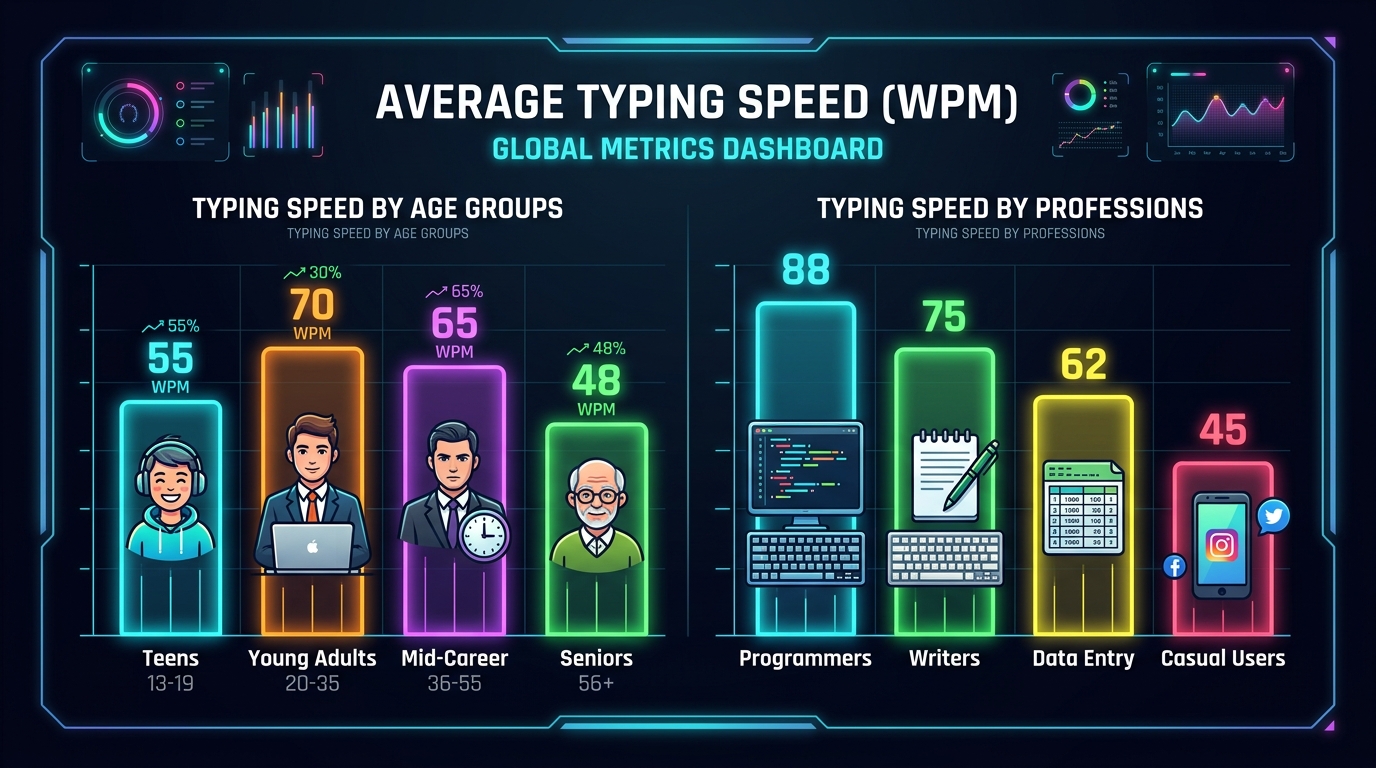
1. Global Baseline: What is the Average Typing Speed in the World?
According to consolidated telemetry data from online testing platforms, the overall global average typing speed across all computer users is approximately 41.4 words per minute (WPM), with an average accuracy rate of 92.8%. In terms of keystrokes, this equates to roughly 207 characters per minute (CPM).
However, what constitutes a normal WPM fluctuates dramatically based on whether a person uses dedicated touch typing (using all 10 fingers without looking at the keycaps) versus visual hunt-and-peck typing:
- Average Touch Typist: 62.5 WPM with 95.2% accuracy. Touch typing provides a 51% speed premium and unburdens working cognitive memory.
- Average Hunt-and-Peck Typist: 31.8 WPM with 89.4% accuracy. Frequent eye-shifting between screen and keyboard creates cognitive fatigue.
- Average Adult Typing Speed: Most working adults fall comfortably between 38 WPM and 45 WPM for routine correspondence.
2. Average Typing Speed by Age Group
Demographic analysis dispels the common myth that younger digital natives always type faster on desktop keyboards. Mobile smartphone familiarity does not automatically translate into QWERTY touch typing mastery:
| Age Demographic | Average WPM | Average Accuracy | Primary Biomechanical Characteristic |
|---|---|---|---|
| Teens (Ages 13–19) | 42.1 WPM | 91.2% | Rapid burst speed but lower accuracy; heavy thumb-dominant habits from mobile texting. |
| Young Adults (Ages 20–35) | 52.4 WPM | 94.6% | Highest performing bracket. Strong desktop immersion from universities and remote work environments. |
| Mid-Career (Ages 36–55) | 45.8 WPM | 95.8% | Exceptional mechanical accuracy and low backspace penalty, compensating for slightly lower raw sprint bursts. |
| Seniors (Ages 56+) | 36.5 WPM | 94.1% | Deliberate, steady cadence with low error rates; prioritizes text accuracy over rapid keystroke cycles. |
3. Average Typing Speed by Profession & Career Role
Different careers demand vastly different typing throughputs. The table below outlines real-world expectations across common professions:
| Career / Role | Median WPM | Top 10% Threshold | Primary Performance Driver |
|---|---|---|---|
| Court Reporters / Stenographers | 180 – 225 WPM | 250+ WPM | Chording keyboards & machine shorthand theory |
| Medical Transcriptionists | 75 – 90 WPM | 105 WPM | Complex anatomical terminology & real-time audio dictation |
| Software Engineers / Developers | 65 – 80 WPM | 95+ WPM | Special characters, brackets (), camelCase identifiers, and command-line terminal syntax |
| Journalists, Editors & Content Writers | 70 – 85 WPM | 100 WPM | Continuous narrative thought transfer and rapid draft transcription |
| Executive Assistants & Paralegals | 60 – 75 WPM | 85 WPM | High-stakes legal documentation where typos carry contractual risk |
| Customer Support Specialists | 55 – 65 WPM | 75 WPM | Multi-chat concurrency and canned response customization |
| General Office Administrators | 40 – 50 WPM | 65 WPM | Spreadsheet data entry, email processing, and meeting minutes |
4. Normal WPM vs Elite: Where Do You Stand?
To understand where your typing speed falls on the global spectrum:
Novice (Below 35 WPM)
Represents the bottom 25% of global typists. Typists typically hunt for letters visually. Switching to home-row touch typing can immediately double this output within 30 days.
Average Typist (38 – 55 WPM)
Represents the 50th percentile median. Adequate for day-to-day computing, browsing, and conversational messaging.
Proficient (60 – 80 WPM)
Top 15% globally. Highly productive speed that enables seamless writing and coding without the keyboard feeling like an intellectual bottleneck.
Master & Elite (90 – 120+ WPM)
Top 2% to top 0.1% globally. Reflexive muscle memory operating at the biomechanical physical limits of human fingers.
5. The Productivity Compound Effect
Test Your Typing Speed Today
Find out your exact WPM, accuracy percentage, and global percentile ranking in 60 seconds.
Start Free WPM Speed Test