
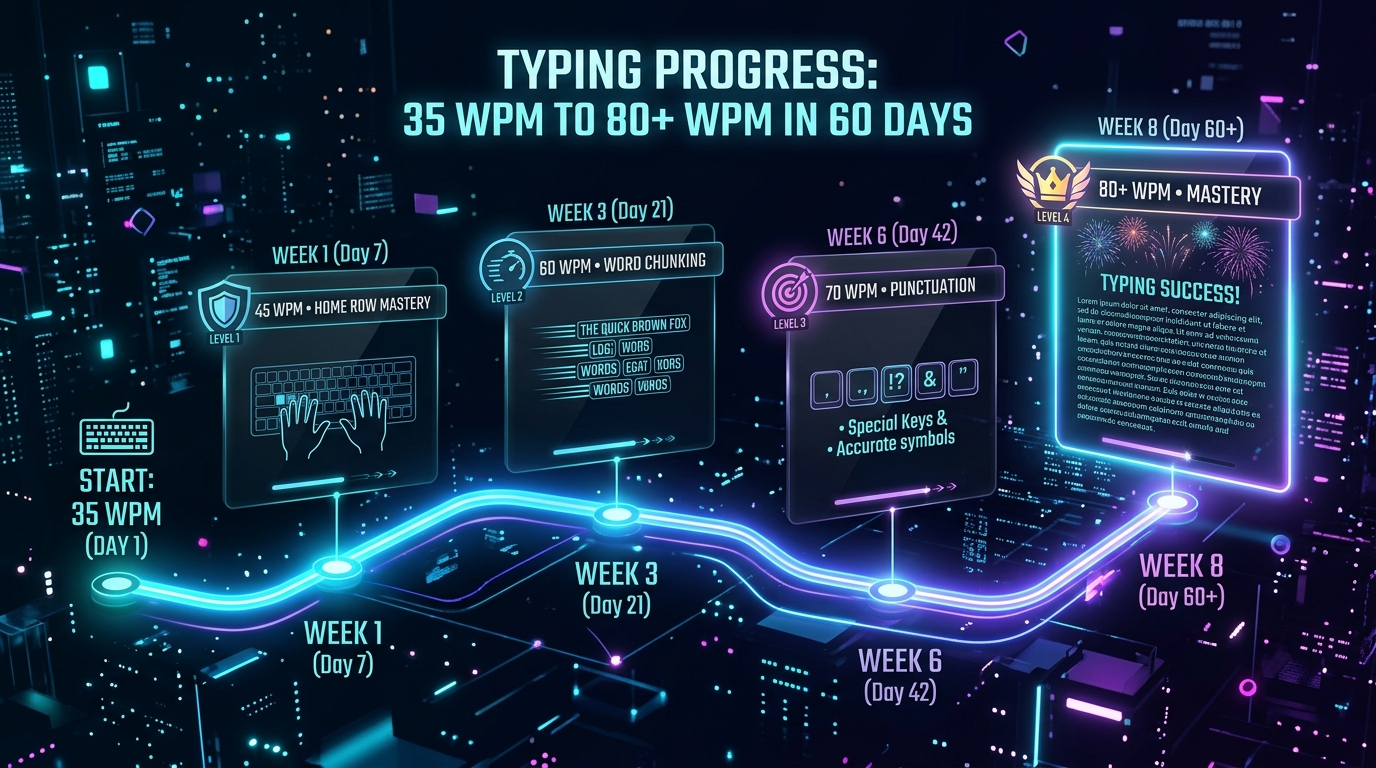
The Plateau Paradox: Simply typing more hours of everyday emails or essays will not increase your typing speed once you hit 50–60 WPM. Passive repetition reinforces habitual inefficiencies. Only deliberate practice with real-time error feedback breaks neurological stagnation.
The Neuroscience of the Typing Speed Plateau
In cognitive psychology, the famous Fitts and Posner Three-Stage Model of Motor Learning outlines how human beings acquire fine physical skills:
- Cognitive Phase: The beginner consciously thinks about finger placement (e.g., "Where is the T key? Reach left index finger up and right."). High cognitive load, slow execution.
- Associative Phase: Movement patterns become smoother with fewer gross errors. You begin touch typing without looking down. (Typist reaches 35 to 50 WPM).
- Autonomous Phase (The Plateau Trap): Actions become entirely automated. Basal ganglia circuits take over, freeing your prefrontal cortex. Once in this phase, your performance stabilizes at an "acceptable level of competence"—and progress halts completely.
A landmark study by Dr. Anna Feit and colleagues at Aalto University (analyzing 168,000 typists) confirmed that typists who remain at 55 WPM for five years and typists who reach 100+ WPM often log the identical number of daily typing hours. The difference lies entirely in how they type.
The 4 Hidden Bottlenecks That Keep You Stuck
1. The Sub-Vocalization Barrier (Reading in Your Head)
Most adults silently "pronounce" words in their inner voice as they read them. Human vocal speech maxes out around 150 to 180 words per minute. If your typing loop relies on: Read Word → Say Word in Head → Trigger Finger Execution, you hit a neural bottleneck around 75 to 85 WPM. Elite typists bypass sub-vocalization entirely through direct visual-to-motor translation: See Token → Fire Motor Reflex.
2. The Look-Ahead Deficit
Slow typists look at the character their fingers are actively typing. Fast typists look two to four words ahead. If you are not buffering future tokens in visual working memory, your fingers must pause after every word to wait for visual confirmation, creating microscopic 100–250ms hesitations between words that destroy your WPM.
3. Asymmetrical Bigram Latencies
Typists do not type words at uniform speeds. You might execute "th" in 70ms, but take 220ms to execute "pl" or "cr". One clumsy two-letter combination (bigram) destroys the kinetic momentum of an entire sentence.
4. The Panic-Backspace Reflex
When you make an error, do you frantically hammer Backspace four times, delete half the correct word, and retype the whole thing? This panic response multiplies error recovery latency by 500%.
5 Deliberate Practice Techniques to Smash Your Plateau
Technique 1: High-Speed Burst Drills (Pushing Physical Ceilings)
To type at 80 WPM, your nervous system must experience what 90 WPM feels like physically. Spend 5 minutes daily typing short 15-second sprints on our Typer Beast 15s Mode. Intentionally type 20% faster than your comfort zone, disregarding errors. This forces your motor cortex to adapt to rapid neural firing.
Technique 2: Metronome & Rhythm Training (Isolating Cadence)
Set a digital metronome to 250 beats per minute. Type one character per click. Smooth, rhythmic consistency is vastly superior to sporadic rapid bursts followed by long pauses. Research shows that elite typists exhibit the lowest standard deviation in inter-key interval (IKI) latency.
Technique 3: Targeted Bigram & N-Gram Isolation
Review which keys cause you to stumble. If your right pinky stutters on P, Q, or Z, isolate those specific keystroke arcs. Practice difficult clusters like "br, cl, gr, pr, tr, th, ch, sh, ion, ment" until they fire as single, unified "chords" rather than individual letters.
Technique 4: The 100% Accuracy Reset
Spend one week doing tests where your goal is zero errors. If you make a single typo, slow your pace down by 10 WPM. Re-establishing clean neural pathways eliminates sloppy muscle memory that degrades high-speed performance.
Technique 5: Hardware Switch Evaluation
If you are typing on a mushy laptop keyboard or an ancient membrane keyboard, verify that your hardware is not limiting your finger rolling. Use our Keyboard Tester & Rollover Diagnostic to ensure all switches register cleanly.
The 30-Day Plateau Breakthrough Schedule
| Week | Focus Area | Daily Practice (15 Minutes) | Target Milestone |
|---|---|---|---|
| Week 1 | Accuracy & Error De-escalation | Strict 99%+ accuracy drills at -10 WPM below ceiling | Eliminate false key strikes |
| Week 2 | Look-Ahead Visual Buffering | Focusing eyes 3 words ahead of current cursor | Smooth inter-word transitions |
| Week 3 | Burst Training & N-Grams | 15s maximum velocity sprints on common words | Desensitize neuromuscular firing limits |
| Week 4 | Integration & Endurance | Full 60s and 120s test runs under realistic conditions | Permanent +10 to +15 WPM breakthrough |
Frequently Asked Questions
Why am I stuck at 60 WPM?
60 WPM is the classic automation ceiling. At 60 WPM, you type fast enough to do all daily tasks, so your brain stops trying to get faster. Breaking through 60 WPM requires deliberately pushing past comfortable speeds using burst training and eliminating looking down at the keyboard entirely.
Does mechanical switch choice help break plateaus?
While hardware cannot replace muscle memory, mechanical switches with light actuation force (like linear 45g switches) reduce finger fatigue during extended sessions. Read our breakdown in Best Mechanical Switches for Fast Typing.